Dance ‘til You Drop: The Medieval Dancing Plague
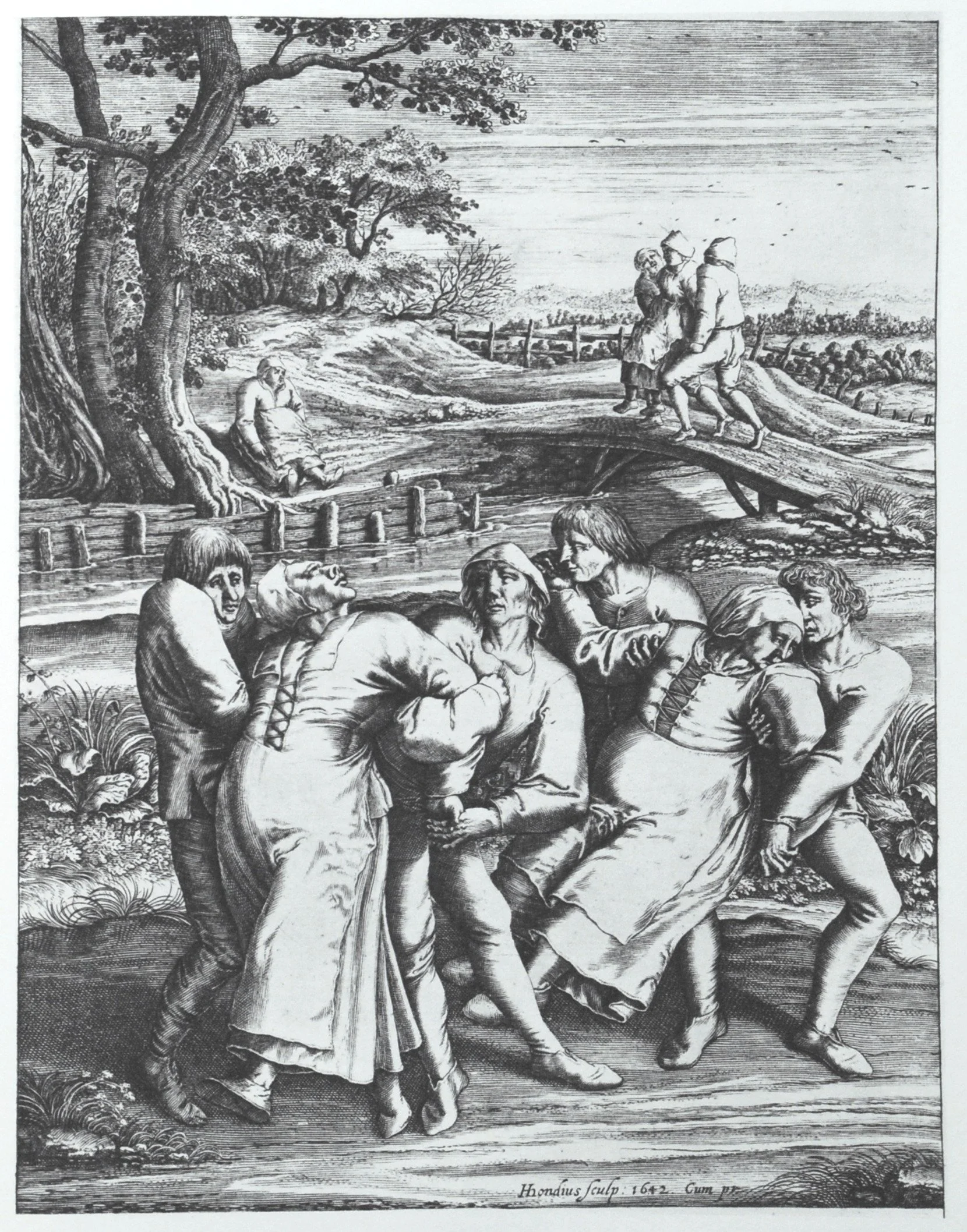
Image in the public domain: “Dancing mania on a pilgrimage to the church at Sint-Jans-Molenbeek,” a 1642 engraving by Hendrick Hondius after a 1564 drawing by Pieter Brueghel the Elder.
I’ve never been particularly adept at dancing. “Leslie” and “rhythm” don’t share a single letter.
However, unlike me, some historical humans didn’t have the choice to spare others their flailing.
Eyup, if you lived in Europe in the Middle Ages, you could very well have come down with a very specific malady: The Dancing Plague.
THE BEST-DOCUMENTED CASE OF THE DANCING PLAGUE
The most famous and well documented outbreak of the dancing plague took place in Strasbourg in 1518. One July day, a woman began dancing in the streets and, almost immediately, a neighbor joined her.
Hey, who isn’t down for some spontaneous celebration? Life’s too short.
Alas, celebration, it wasn’t.
The woman and her neighbor didn’t stop dancing. They danced nonstop, day and night. Over the next few days, more people joined them, some of whom begged bystanders to help them, save them, make it stop.
Reports vary, but some indicate that nearly four hundred people became afflicted before the end of the outbreak. (I couldn’t find a trustworthy source for the population of Strasbourg in the early 1500s, but that’s a heck of a lot of people for a town in medieval times.) Some of the dancers succumbed to exhaustion, stroke, and heart attack from the nonstop frenzy.
At what could only be called a loss for ideas when it came to what to do about the outbreak, Strasbourg built a dance floor and hired musicians. Let ‘em dance it out, they decided.
BUT THAT WASN’T THE FIRST OUTBREAK
Because this had happened before.
European outbreaks of the dancing plague started in the 7th century. By the 1500s, when this one hit Strasbourg, epidemics of frenetic dancing were a known thing.
Why?
Anyone’s guess, really. None of the posited theories have held enough water to be deemed definitive. Not the one about the accidental ingestion of hallucinogens, not the one about dancers’ being part of a cult, and not the one about the curse of St. Vitus.
Interestingly, just as the frenzy eventually died out in Strasbourg (approximately two months after it started—can you imagine?), dancing plagues wound down in Europe around the 17th century.
And again, no one knows why.
I’LL TAKE A PASS ON THE DANCING-PLAGUE EXPERIENCE
Back when I was at university, I remember dance-marathon events that raised money for charity. (Do those still happen?) I also loved Horace McCoy’s novel They Shoot Horses, Don’t They?, centered on a dancing competition with a cash prize for the couple that danced the longest.
My elementary school even had us do U.S.-style square dancing during our physical-education program, a form of dance not too dissimilar from Avignon’s famous dance under (or on, depending upon your historical source) the famous bridge there.
A dancing plague, though? Not, fortunately, something I’ve experienced, not even in Strasbourg, a city I’ve loved to visit (and you might, too.)