What to Do on Vacation in Périgord Noir
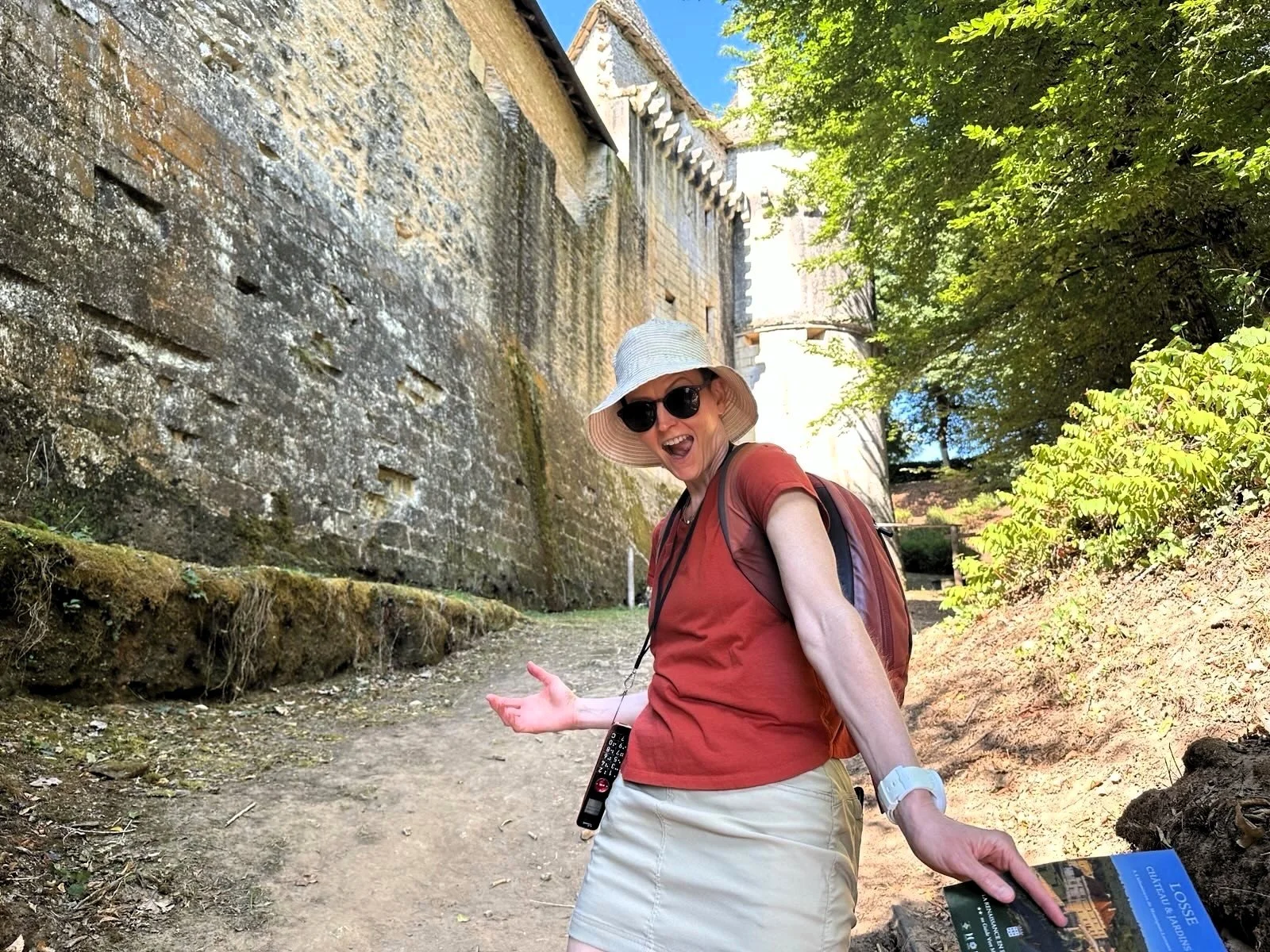
Mugging for my spouse’s camera at the Château et Jardins de Losse, rocking my audio guide like a necklace. August 5, 2025. Montignac, France.
Before I begin, I’ll note front and center that the French region known as Périgord is also often called Dordogne.
And to make things even more confusing, Périgord Noir is also often called Sarladais.
Worth keeping all this in mind if you decide to visit Perigord Noir (also known as Sarladais, also known as Dordogne) and need to plan your trip. Yes! You’re not losing your mind! These are all, by and large, the same place!
I note this to save you my headache when planning a vacation to this region. I kept getting confused and turned around. If you read this post as part of your own vacation planning, I hope I’ve saved you at least a little of that same confusion.
When planning a trip to tour around somewhere, in no matter what country, I seek out a base of stay from which we can radiate to everything we’d like to see without too much distance to drive each day, even if a long drive might be unavoidable on a day or two.
For our base of stay in Périgord Noir, we opted to call Montignac home. The town doesn’t have much to see, but it’s well situated for getting around the region, and it has several restaurants in the town center and a few small grocery options on the routes into and out of town.
Ah, and as you probably gathered: Yes, you will need to have a car for a trip to Périgord Noir. Click here if you want a quick primer on the rules of the French road.
How about Some Medieval Castles?
During the 100 Years War between the French and the English, this region of France was the site of shifting boundaries, alliances, and allegiances. Throughout the territory, you’ll find medieval castles in various states of restoration that served the English, the French, and both, depending on the moment and the shifting dynamics.
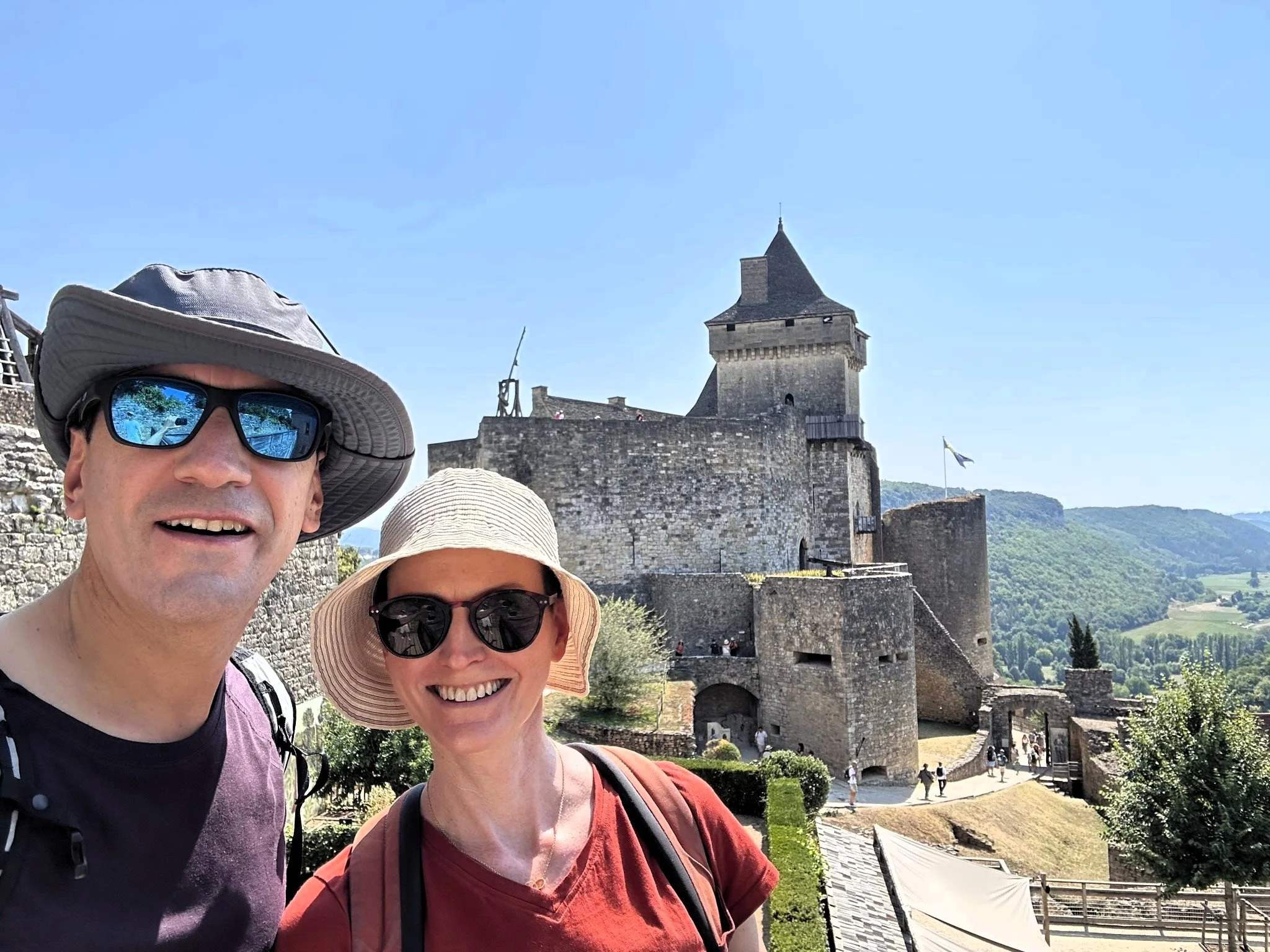
The best selfie-taker on the planet (my husband) and you-know-who standing along one of the Château de Castelnaud ramparts. August 8, 2025. Périgord Noir, France.
So if choose to see a medieval castle while in Périgord Noir, you’ll have your pick of options. We couldn’t come close to seeing them all in the several days we had in the area.
My thoughts on the ones we saw:
Château de Castelnaud: Castelnaud was hands-down the best of the medieval castles we saw on our Périgord Noir visit. The site is well organized and informative, with several interesting videos and informational presentations, of which we caught three: a demonstration of the trebuchet, an overview of large-scale medieval weapons, and a presentation about medieval hygiene. (As to the latter, it was a relief to have some debunking of information about medieval people being dirty and nasty and brutish.) The castle gave me a new perspective on the 100 Years' War, with which I'm only lightly familiar, and I liked seeing the medieval war machines laid out in order of development, which provided a good illustration of how and when certain war technology developed and why (e.g., the trebuchet and the barbican coming into practice after the Crusades, the canon after the introduction of gunpowder following trade routes opening with Asia, and then certain technologies evolving with humans’ greater understanding of physics and how to counterbalance weights and projectiles).
Château de Commarque: From reading the Michelin guide we’d purchased, I didn’t have the highest hopes for Château de Commarque. The description didn’t seem to jibe with the three-star designation. Turns out my low expectations were justified. The “château” is barely more than a slightly cleared-off ruin. We opted for the guided tour, but the guide said a few things that made me question her knowledge—a definite turn-off. (I think I knew more about medieval history than she did.) The audio guide on offer might have been a better option, so if you visit Commarque, give that a try. One fun fact, though, that I gleaned on our visit: The town or village that the castle managed used the surrounding cliffs as the city walls. Most of the medieval cities I’ve heard about or visited sprung up around a water source and then built walls around the town. This one, though, had natural fortifications.
Château et Jardins de Losse: Originally built by the Losse family in the 11th century, the property owes its current form to its Renaissance-era proprietor, Jean de Losse, a military strategist and politician. The site offers a high-quality audio tour with a succinct and informative overview of the history of the grounds and buildings. A final castle-related fun fact: At one point during the 100 Years’ War, a Scottish soldier stationed here was named the right-hand man of the newly installed king (the former Dauphin, who was supported by the Catholic contingent). The soldier’s name was A. Houston. He descended from a man named Thomas Houston, who had served as a soldier in the war with Joan of Arc. One of the descendants of A. Houston, the man stationed at Losse, became Sam Houston, who gave the U.S. city of Houston its name. How’s that for an unexpected bit of information to get when standing in the bottom of a restored medieval tower in the middle of the French Périgord?
Visit at Least One of Several Cliff Towns
Périgord Noir is a land of peaks and valleys (as you’ll note when you drive through it, because it will take you forever to get anywhere).
This means many of the region’s towns, to get a height advantage, situated themselves on the top of cliffs. These cliff towns are now popular stops for tourists, who hike to the top to explore the towns’ winding streets and see the stone architecture, all while gaining a panoramic view of the landscape.
Even if you simply choose to drive by and admire the towns from the road below, they are impressive to see, their buildings and streets winding ever farther up the cliff.
We decided we couldn’t come to Périgord Noir without hiking up into one of these towns, even if we didn’t have time to stop at them all.
We chose to visit Beynac-et-Cazenac, though we drove past La Roque Gageac and Domme to admire them from the road.
The hike up to Beynac-et-Cazenac helped us digest our lunch—and helped me get over a little of my motion sickness from all the winding roads you need to take when you visit this region (keeping it honest!) and it really did wow us with its views.
The centerpiece of the town is its 13th century medieval fortress, which is very well maintained (and restored). If you climb all the way into Beynac-et-Cazenac just to visit the village and pass on entering the castle, you’ll miss out.
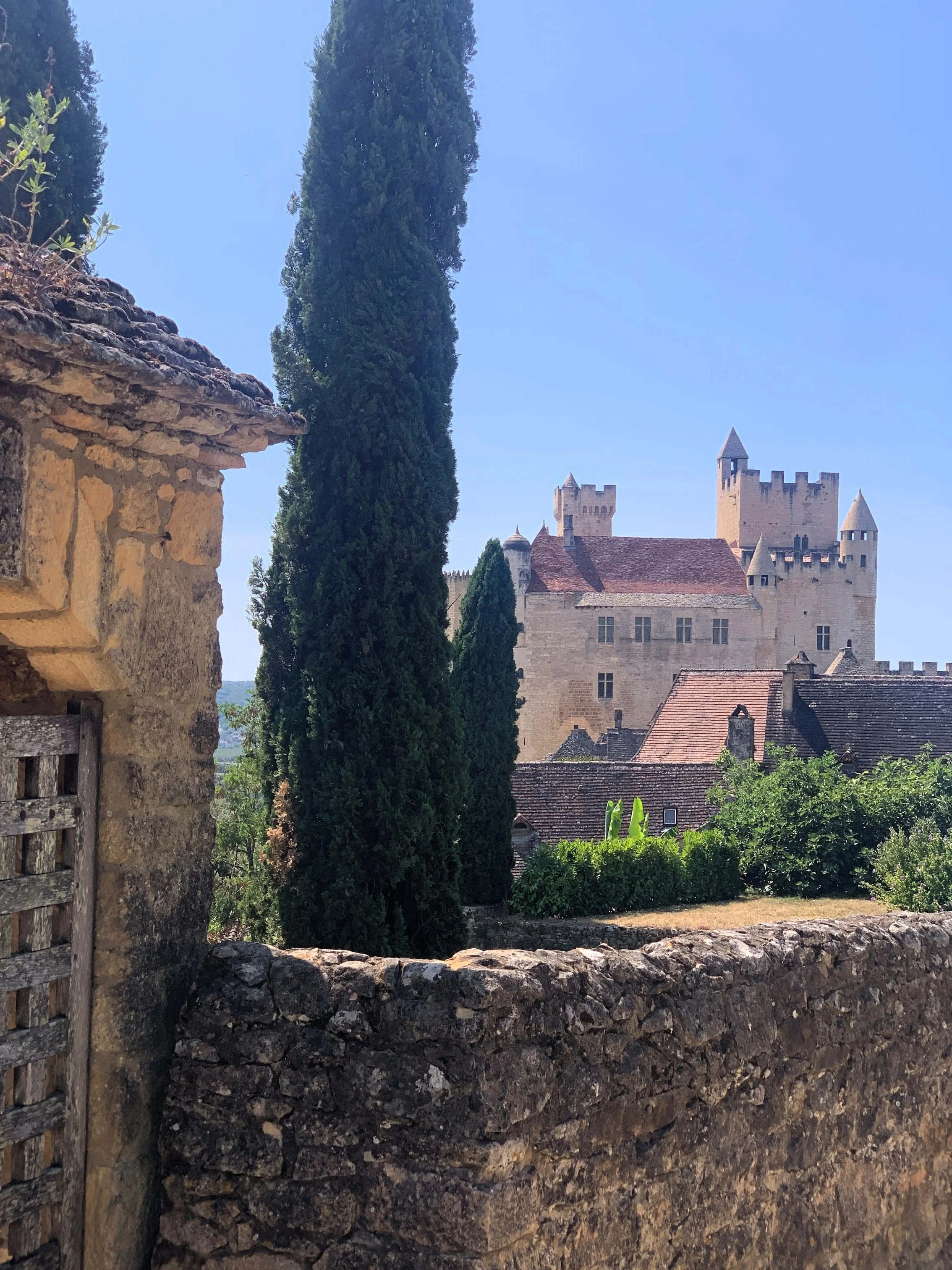
A view of the château of Beynac-et-Cazenac from one of its winding medieval streets. August 6, 2025. Beynac-et-Cazenac, France.
Note: This kind of hike wouldn’t be ideal for someone with mobility issues, so keep that in mind. Also worth knowing is that even the fittest of travelers shouldn’t visit one of these towns without sturdy shoes that have good traction. I saw far, far too many people trying to make it up and down the slope in what I’d call “fashion sandals,” and they did not look like they were having a good time.
See Cave Towns, Too
Sure, Périgord Noir has towns on cliffs, but fear not: It has towns in caves, too.
The most complete, restored, and well explained, in our experience, is La Roque de Saint-Christophe. We visited it somewhat on a lark, without expectations, and walked away considering it one of the must-sees of the region. Highly, highly recommended.
When you arrive, it won’t look like much. But trust me, when you walk up the ramp and into the city, which was quite literally carved into the cliff wall, you’ll be stunned. La Roque de Saint-Christophe had five levels or floors and over a hundred rooms or spaces. In its 14th century heyday, it housed approximately 1,400 people.
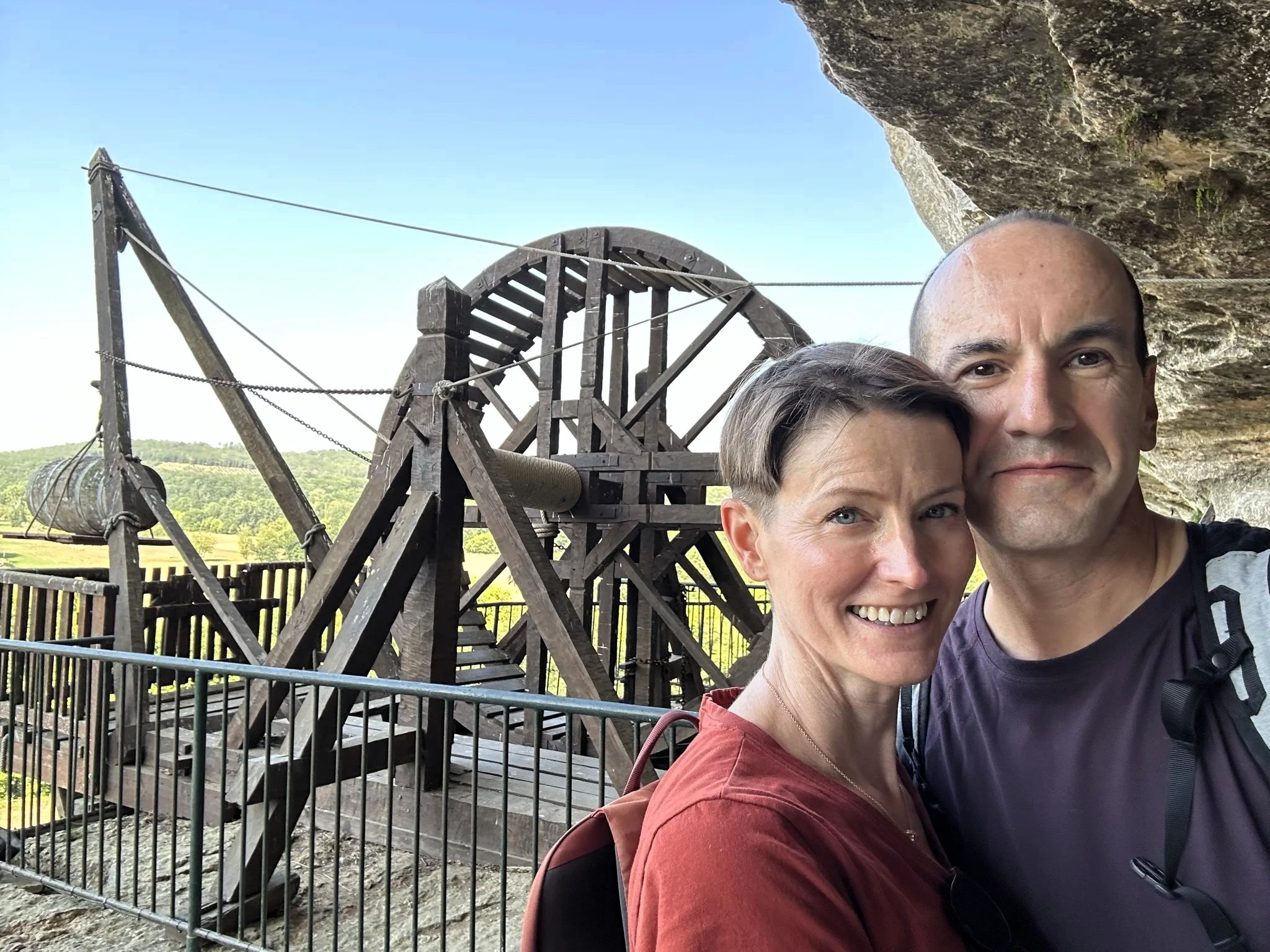
Again, credit to the best selfie-taker in the world for this photo! The two of us standing near a recreation of one of the machines that made La Roque de Saint-Christophe possible. August 8, 2025. Périgord Noir, France.
The site offers several different guided visits; we attended more than one, they were so much fun and so educational. In addition to touring some of the rooms and spaces and learning how they were furnished and used, you’ll see reconstructions of the medieval machines used to defend and construct the site and make a cliff-dwelling life possible, including levers and pulleys. Fascinating stuff.
Also, archaeologists working on the site have found remains that indicate humans have used this stretch of cliff as shelter since prehistoric times—long, long before the middle ages.
Medieval Sarlat-la-Canéda
No to towns on cliffs and caves? Or yes-and, all-in for cliff and cave towns, but how about another type of town?
Périgord Noir’s got you covered.
One of the area’s most well-known towns for tourists to visit is Sarlat-la-Canéda, a place that saw an opportunity to attract tourists and shops and visitors by restoring its medieval architecture and layout—and went for it. Given the throngs of people who visit each day, their gamble paid off in spades.
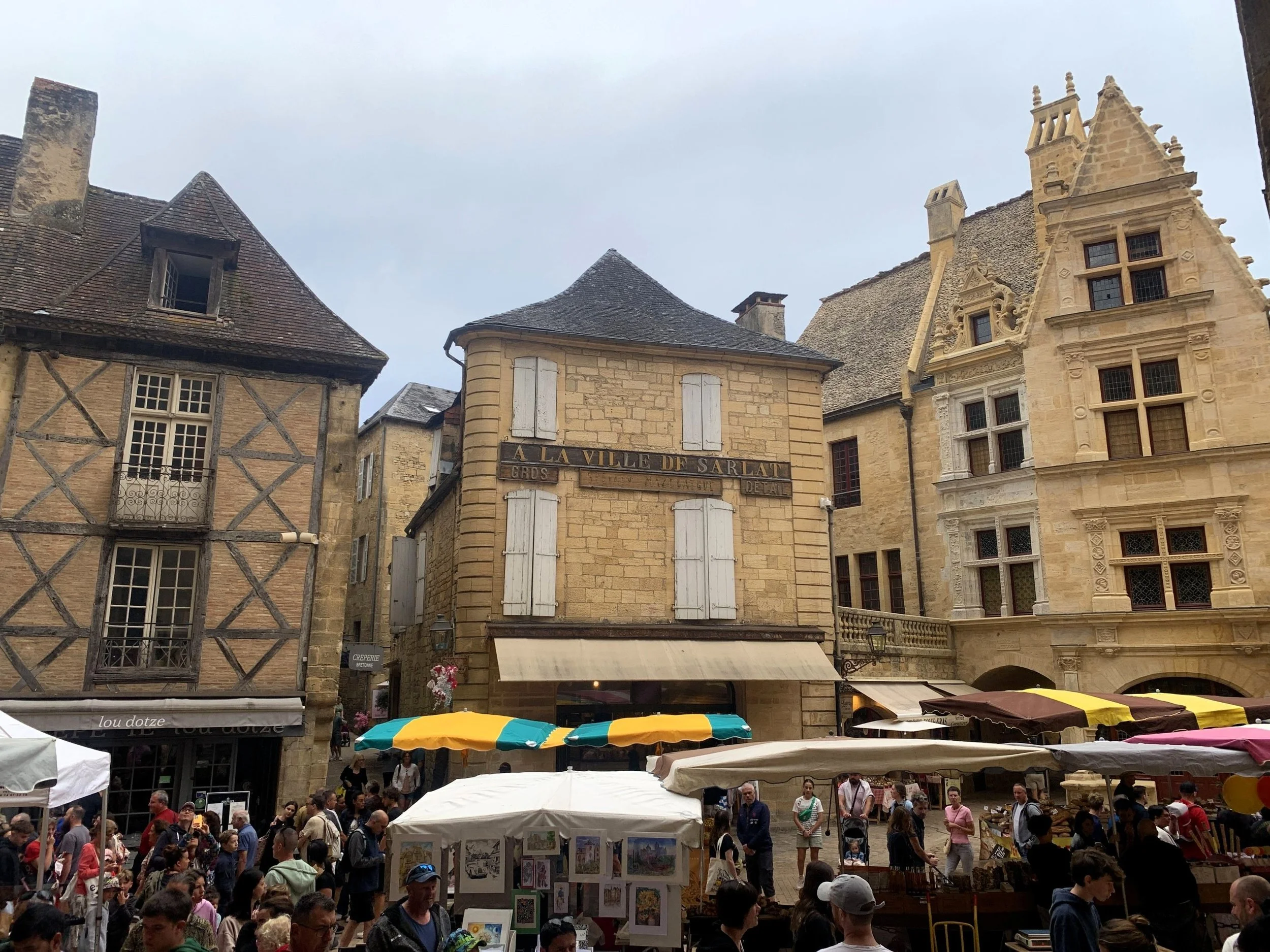
A rainy-day view over one of Sarlat-le-Canéda’s medieval squares on a market day from the grand entrance of its Saint Sacerdos Cathedral. August 6, 2025. Sarlat-le-Canéda, France.
The old town has the classic narrow, short medieval streets lined by three- to five-story buildings that they’ve restored to medieval splendor. In all seasons—and especially the high-tourism seasons—you can reserve walking tours of the town from the tourist office. (Reserve in advance: The tours are popular!)
We appreciated the walking tour’s context for the town’s history and evolution; otherwise, we would have passed a lovely day seeing the market, stopping into shops, and eating lunch at a restaurant tucked into one of the squares, but we wouldn’t have known as much about Sarlat-la-Canéda’s development from the late 9th century through to its golden age in the 16th, after King Charles VII accorded the town special financial privileges—lowered taxes, higher revenue—in gratitude for its service during the 100 Years’ War.
Note: During the high tourist season, the town asks visitors to park in a large lot outside its center and take a shuttle into the old town. The shuttle leaves only every thirty minutes. Worth keeping this in mind if you book a tour, have reservations somewhere, or would like to visit the town within a certain timeframe. We didn’t know about this restriction and almost missed our walking tour’s start time.
See Prehistoric Art and Learn about Prehistoric Times
Périgord Noir is well known for its copious prehistoric sites, and the cave paintings at Lascaux may be the most famous of the famous.
No one but scientists can today enter the caves to see the prehistoric art, which exposure to hordes of tourists have already compromised. However, you can visit a full-size recreation of the cave in its entirety—and you should. It’s astounding to see what our predecessors were able to realize so many thousands of years ago.
I struggle to imagine how they painted these images in a cave that dark, even with oil lamps. How many oil lamps did they have going at one time? How far could these little lamps possibly cast their light? How did the artists even know where to wander down in there? How many people were involved at one time in the work, whether in painting or assisting or even lighting? And were all these paintings done in a single generation or were there several generations of artists at work over a series of years or even centuries?
Mind-blowing, really.
And more incredible: The guide said the artists used wood scaffolding to paint on the ceilings, which required them finding wood in far-off lands and transporting it back. In the painters’ time, these lands did not have trees.
You’ll need to reserve your visit time in advance. In the high tourist season, if you have a specific day you’d like to visit, book your tickets as far in advance as you can. As you can imagine, this is a highly popular destination for throngs of visitors from all over the world.
But while you’re in the region, do not assume seeing the Lascaux caves checks off the “prehistory” portion of your Périgord Noir visit.
While I would not have missed seeing the cave art, our visit to the prehistory museums in Les Eyzies gave me a much deeper understanding of the prehistoric period, blowing apart all of my preconceived notions in the best of ways.
Start at the Pôle d’Interprétation de la Préhistoire, which will give you a backgrounder you’ll need before you can appreciate the town’s biggest attraction, the National Museum of Prehistory.
The entrance floor of the Pôle d’Interprétation de la Préhistoire is for children, which almost made us think we should just push on. I’m glad we kept exploring. Descend to the floor below the entrance for the full backgrounder for adults and children. You’ll get a helpful overview of the prehistoric timeline and context for why this area is so rich in prehistoric settlements and artifacts.
That done, continue on to the National Museum of Prehistory, where you’ll now have the orientation you need to appreciate its impressive reminder of how long humans have existed and how clever even the earliest communities were. They made art, they thrived (not just survived), and they cared for each other. We want to think of them as “primitive” and “savage,” and that’s an injustice.
My favorite artifacts in the collections were two carved ornaments: A bull turning back to lick its flank and two deer-like animals in motion.
Also, before you leave the museum, wander out onto its terrace, which has a beautiful view overlooking the valley.
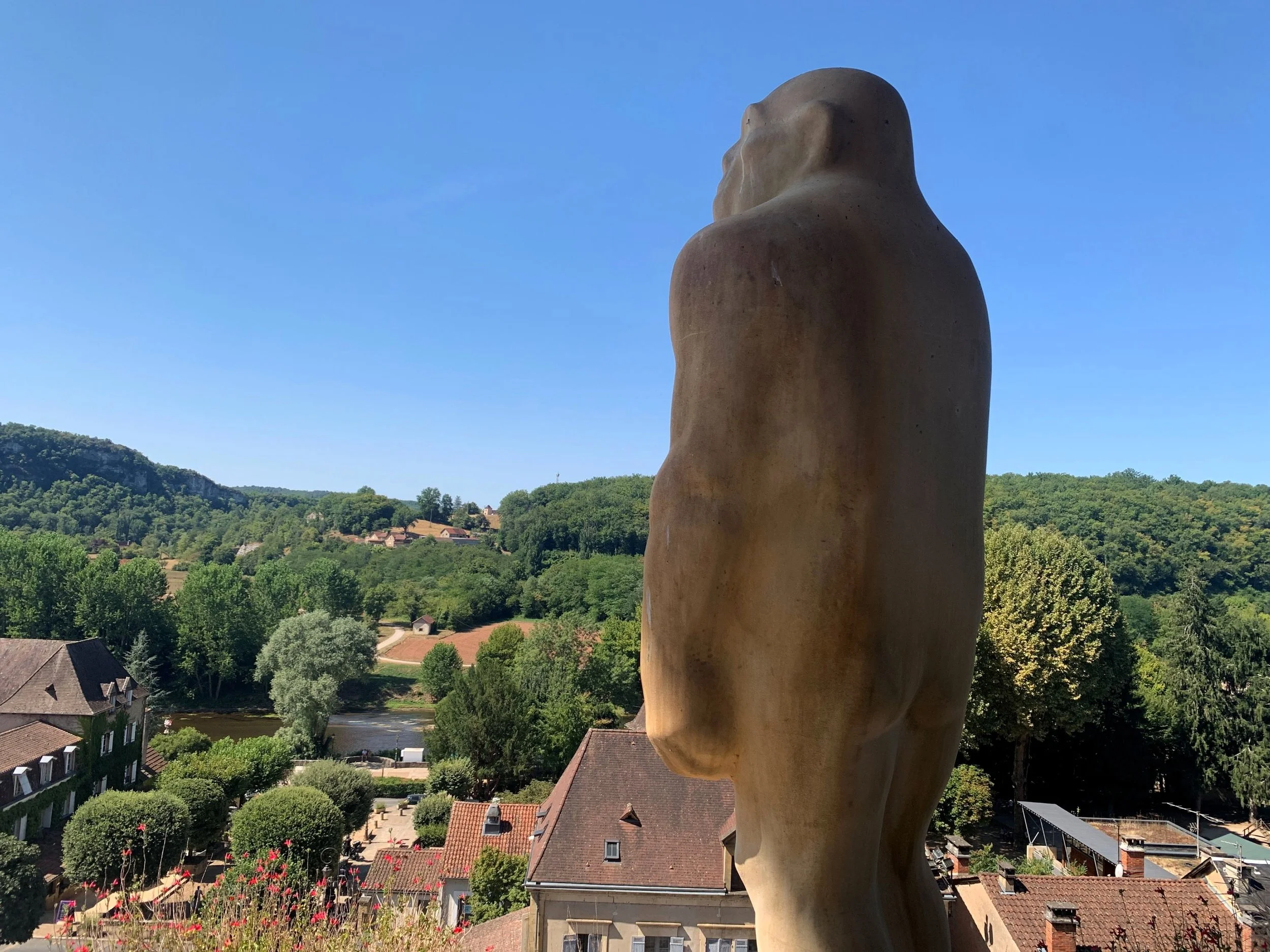
A view over the area from the terrace at the French National Museum of Prehistory. August 7, 2025. Les Eyzies, France.
Note: If this trip whets your appetite for more travel related to prehistory, I highly recommend a trip to Ardéche and Drôme.
Canoeing and Kayaking on the Vézère and Dordogne Rivers
Périgord Noir is immensely popular with outdoor-adventure lovers, who come here to camp and hike and to canoe and kayak on the Vézère and Dordogne rivers.
Even if you don’t want to spend your vacation hiking or go the camping route, don’t discount spending a day floating peacefully down one of these two rivers. The Vézère and Dordogne are wide and have gentle currents along their most frequented routes, negating the need for any measure of technical skills. Inexperienced canoe and kayak adventures welcome.
Now, most of us don’t travel with our very own canoe or kayak, but you won’t have a lot of trouble finding places to rent them along the river in the summer season. You don’t even need to reserve in advance, you’ll have so many options. But if you’d rather not just drive up to a random outfitter, ask at your place of stay if they have any recommendations for an equipment-rental place most convenient to where you’ll be.
The breadth of the rivers means you’ won’t have any shade on the route, so bring copious sunscreen and a hat and consider wearing more than just a swimsuit. And don’t forget to bring along enough water for the hours you plan to spend and the heat of the season.
A final note: One of the especially fun aspects of canoeing and kayaking in Périgord Noir, especially in the summer season, is all the other canoe and kayak adventurers you’ll meet. The rivers are packed—and in the best way.
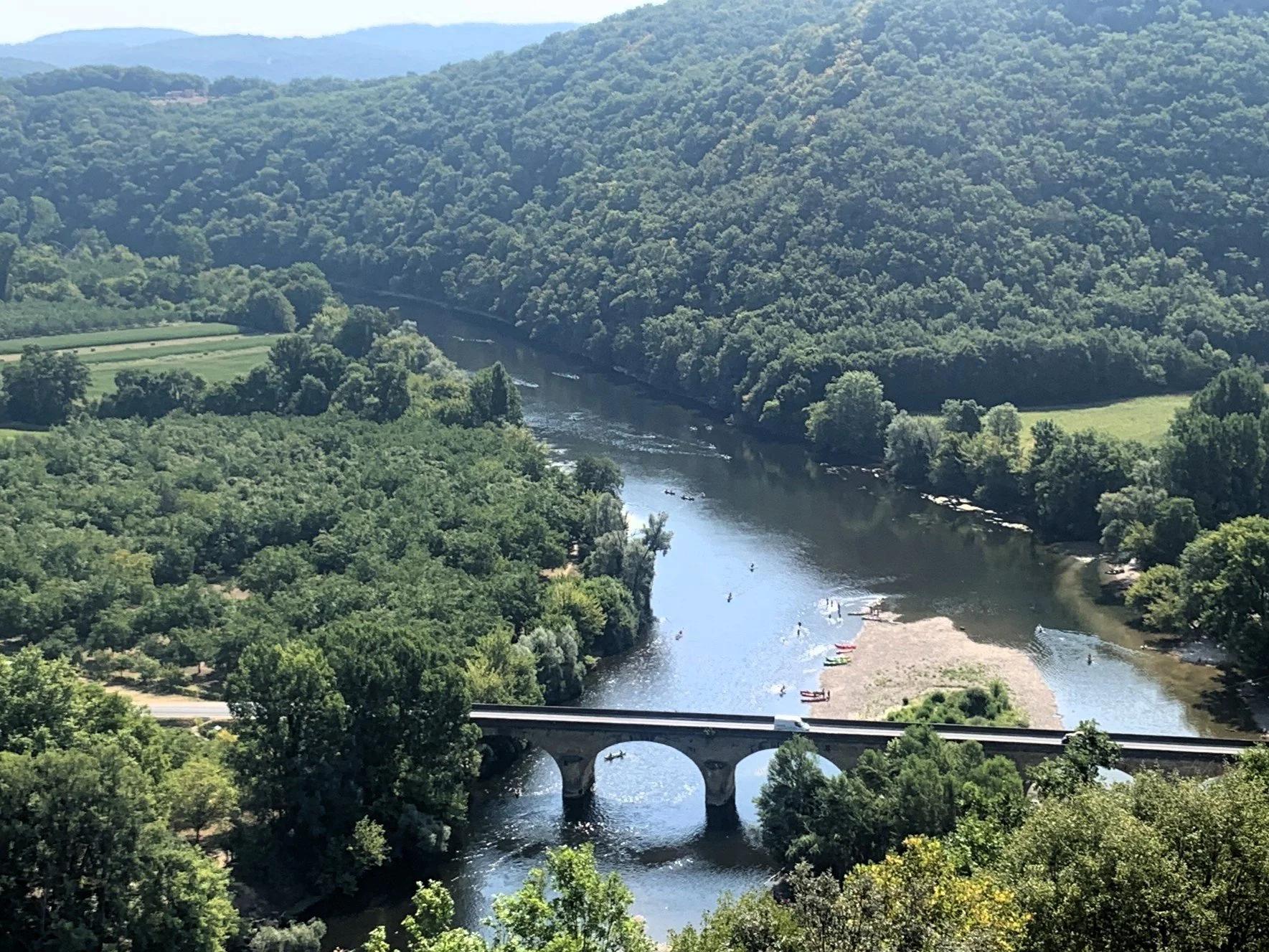
A view from the Château de Castelnaud ramparts over the Dordogne River, dotted with canoes and kayaks. August 8, 2025. Périgord Noir, France.
I Loved Our Trip to Périgord Noir
Before our trip, I worried that a visit to Périgord Noir would be boring. Wrong. To see anywhere close to everything there is to see, we would have needed twice the amount of time we had.
I learned so much on our travels here and learned I have so much more to learn, too—and that’s always a fun experience.
There’s something about going to a place that makes real what you knew before you got there, and something else entirely about going somewhere you know nothing about and discovering worlds of culture and history that open your eyes.